

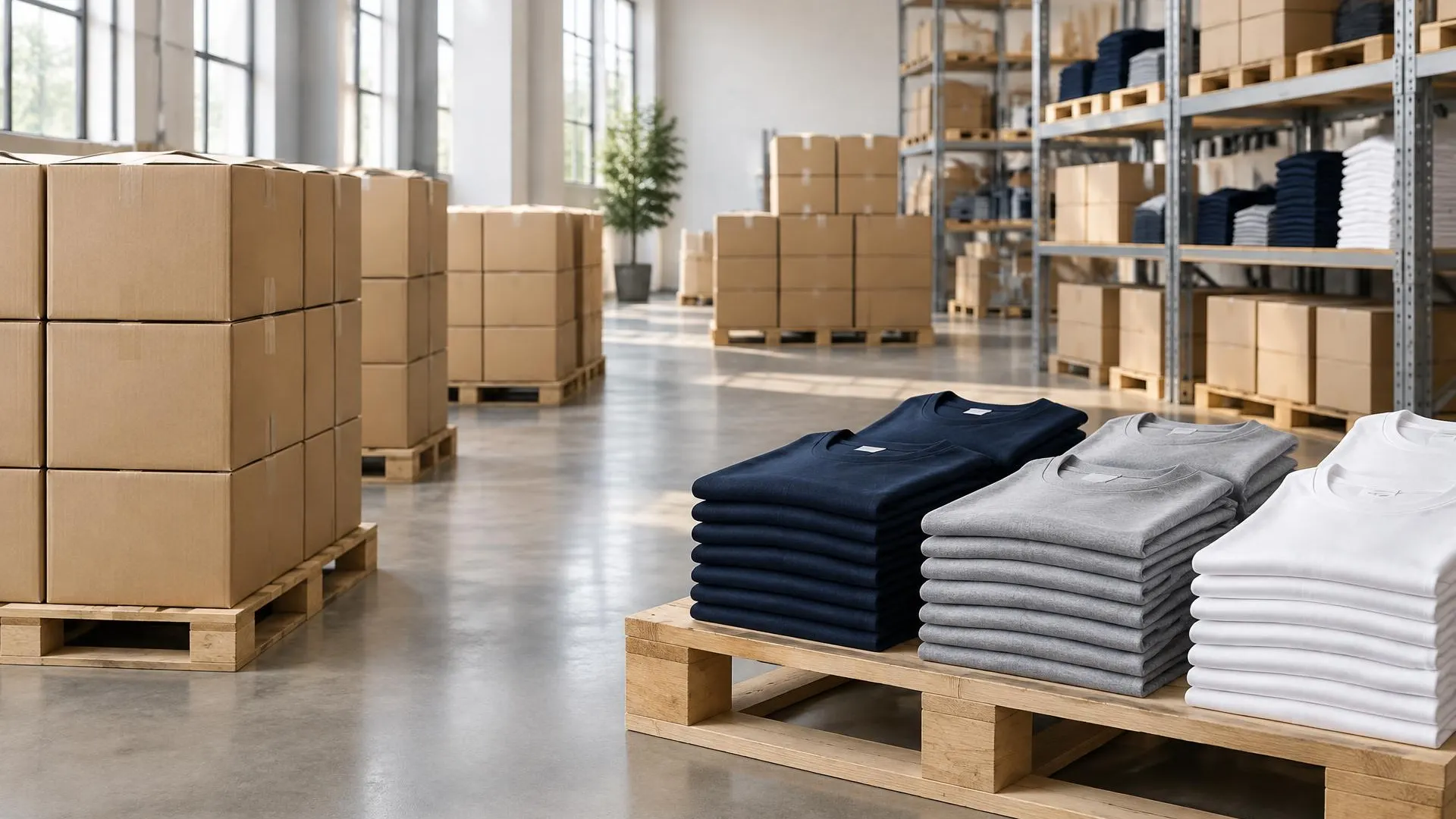
A company-wide apparel rollout succeeds when four things are locked early: the exact styles and colors, a size curve for every location, one approved proof used by every production partner, and a delivery schedule that works backward from the date people need to wear it. For runs of 5,000 to 20,000 pieces, start planning eight to twelve weeks out.
Step 1. Define the program
Who receives apparel, how many people, how many locations, and the date it must be in hand. Decide whether this is one drop or a program with reorders.
Step 2. Choose styles that stay in stock
Pick widely stocked styles in core colors, and name a backup style for each before you approve. Large runs can drain one warehouse's stock of a single color and size.
Step 3. Build a size curve for every location
Collect sizes from employees when possible. If you cannot, use past orders by location. Keep a small buffer in the most common sizes and include extended sizes.
Step 4. Approve one proof for everyone
One proof sets the artwork, colors, placement and print size. When production is split across partners, every partner works from that same proof.
Step 5. Schedule production and shipping in waves
Large runs are often produced in stages and shipped in waves, with the locations that need apparel first scheduled first.
Step 6. Pack and label by location
Each location receives cartons labeled with location name and size breakdown, so managers can hand out apparel without sorting.
Timeline
| Weeks before in-hands date | Step |
|---|---|
| 10 to 12 weeks | Define program, budget and quantities |
| 8 to 10 weeks | Choose styles and backups, collect sizes |
| 6 to 8 weeks | Approve mockups and the production proof |
| 3 to 6 weeks | Production, in stages if needed |
| 1 to 3 weeks | Shipping in waves to each location |
Timing depends on quantity, decoration and stock. Your quote states a firm in-hands date.
Planning a rollout of 5,000 pieces or more? Start a large program.
Frequently asked questions
- How long does a 10,000 shirt order take?
- Plan eight to twelve weeks from first conversation to delivery for the smoothest result. Production itself is scheduled at quote and can be split across partners to meet your date.
- How do we handle sizes for thousands of employees?
- Collect sizes from employees where possible, otherwise use past orders by location, and keep a small buffer in the most common sizes.
- Can every location receive its own sizes?
- Yes. Cartons are packed and labeled by location with each location's size breakdown.